
One of the most beautiful realizations in modern biology is that our body is a living archive. While we often imagine evolution as a lonely, competitive race where only the “fittest” survive, the true history of life tells a much warmer story. It’s a story not of solo struggle, but of radical, permanent friendship. We are what scientists call biological mosaics: a living collection of different lineages that decided, billions of years ago, that they were better off together than apart.
This is the heart of the Endosymbiotic Theory. It suggests that the tiny power plants humming away inside your cells right now weren’t always “yours”. Once, they were independent, free-living bacteria wandering the ancient seas. Then, in a moment of extraordinary collaboration, they merged with our ancestors to create something entirely new.
Every breath you take and every thought you have is powered by a billion-year-old handshake – a legacy of cooperation that changed the world forever.
The Host: A Mysterious Ancestor
For nearly fifty years following the formal proposal of the theory in 1967, the identity of the “host” cell remained one of biology’s greatest mysteries. While we understood the “guest” was a bacterium, we could not find a living relative of the organism that did the swallowing. This changed in 2015 with the discovery of the Asgard archaea, which was finally revealed through the analysis of sediment from the Arctic Ocean floor. Named after Norse mythology, these organisms represent a “missing link”. They possess genetic instructions for complex cell movements that researchers previously thought only existed in higher life forms. This suggests that our ancient host ancestor already had the ability to reach out and pull other cells inside itself, setting the stage for the most important merger in history.
The First Great Merger
This journey toward complexity began nearly two billion years ago. A member of the archaea group internalized, likely through an early engulfment-like process, a smaller bacterium. However, in a pivotal accident of history, a swallowed bacterium managed to survive inside its captor.
For the betterment of living, a symbiotic partnership formed. The archaea host provided a safe, nutrient-rich environment, while the tiny resident bacterium provided a massive surplus of energy. This internal power source allowed the host cell to grow larger and more complex than ever before. Over millions of years, this resident evolved into the mitochondrion, the organelle that still powers every breath we take today.
The Second Great Merger
Roughly half a billion years after this first merger, a second major event occurred that would eventually turn the Earth green. While many cells were now powered by mitochondria, they were still “hunters” that had to find food to survive. Meanwhile, a different group of tiny organisms, cyanobacteria, had mastered the ultimate biological superpower: the ability to turn sunlight into food.
In a repeat of the original merger, a predatory cell engulfed one of these solar-powered bacteria but failed to digest it. The captured bacterium continued to perform its work inside its new home, leaking sugar and oxygen into the host. This effectively gave the host cell its own internal solar panel. This momentous event gave rise to the entire lineage of algae and, eventually, every blade of grass and towering tree on our planet.

- The First Great Merger: The endosymbiosis between an Asgard archaeal host cell and an Alphaproteobacterium led to the first complex eukaryotic cell with mitochondria. This event made the large, complex cells of animals, fungi, and protists energetically feasible.
- The Second Great Merger: In a subsequent, separate event, an early eukaryote that already possessed mitochondria engulfed a Cyanobacterium. This resulted in the first plant/algae cell with chloroplasts, enabling photosynthesis. All organisms with chloroplasts also have mitochondria, but not all organisms with mitochondria have chloroplasts, which supports the order of these events.
The Evidence in Our DNA
1. Phylogenetics: When we sequence the DNA found inside mitochondria, it does not match the DNA in our nucleus. Instead, it is phylogenetically traceable to a specific group of ancient bacteria called Alphaproteobacteria. It is a genetic “ID card” that proves their ancestry. Furthermore, this DNA is circular, the exact same closed-loop shape found in bacteria, whereas our host DNA is linear.
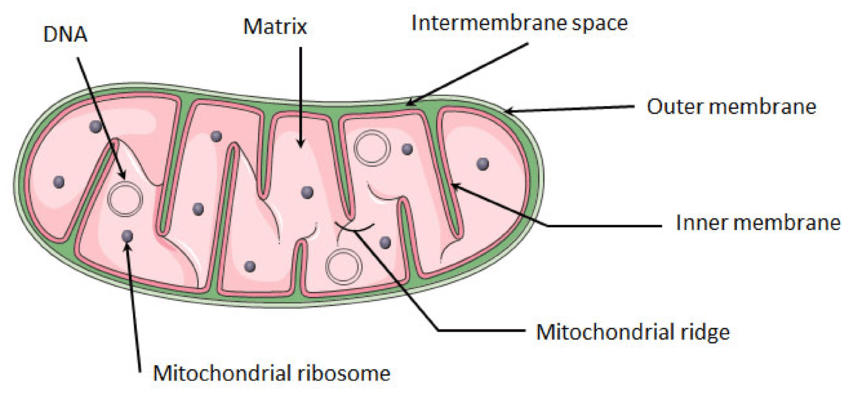
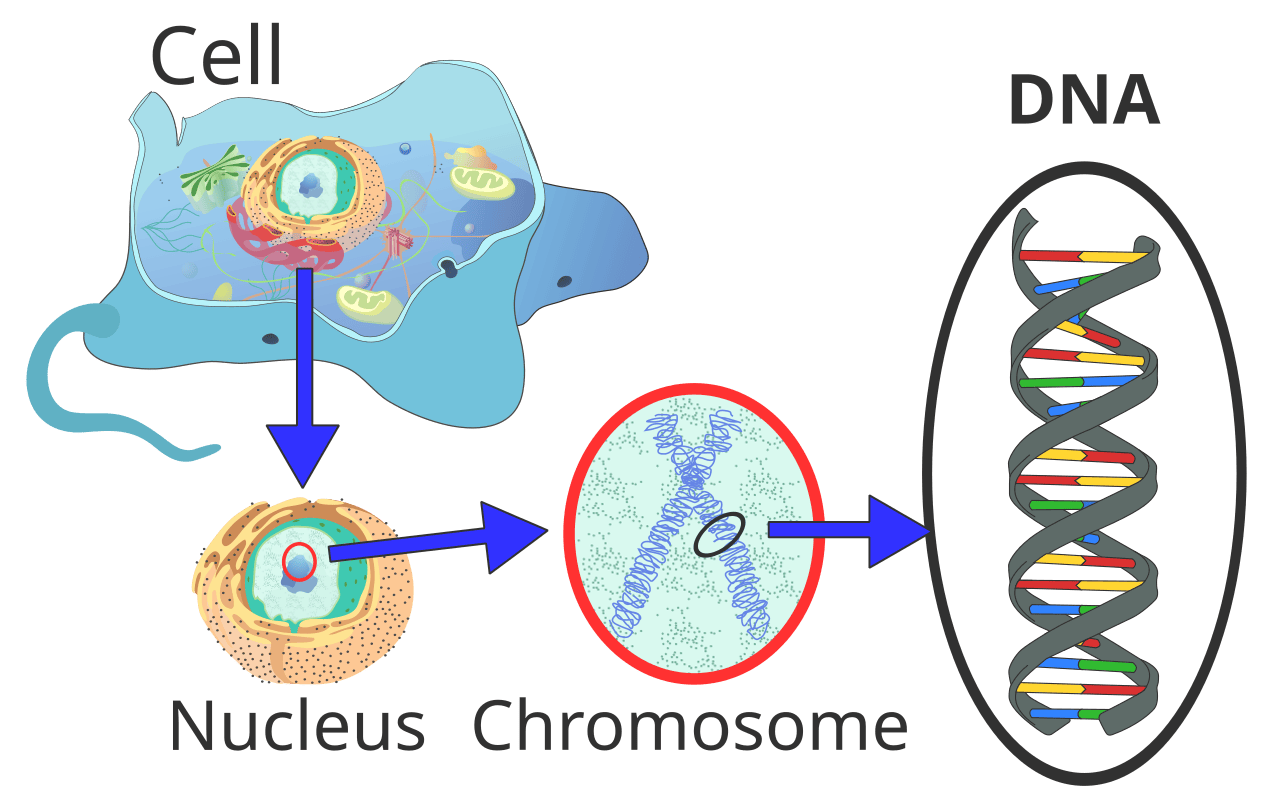
2. Double Membranes: If you were to swallow a marble, that marble would be inside your stomach, wrapped in your stomach lining. This is exactly what we see in these organelles. They are wrapped in two distinct membranes:
The Inner Membrane: This is the original “skin” of the ancient bacterium. It even contains a unique fat called cardiolipin, which is found in bacteria but almost never in the rest of a human cell.
The Outer Membrane: This is a remnant of the host cell’s “stomach” from when it first engulfed the guest.
3. Ribosomes: Cells build proteins using tiny machines called ribosomes. Human cells use large 80S ribosomes, but bacteria use smaller 70S ribosomes. Fascinatingly, your mitochondria still use the bacterial 70S version. This explains why certain antibiotics can make you feel tired; they are designed to attack 70S ribosomes in “bad” bacteria, but they accidentally hit the “good” ones living inside your cells.
4. Binary fission: The nucleus cannot “build” a new mitochondrion from scratch. Instead, these organelles reproduce exactly like free-living bacteria: they simply split in half
Together, these genetic, structural, biochemical, and phylogenetic signatures converge on a single conclusion: mitochondria and chloroplasts are not native inventions of the eukaryotic cell but the living descendants of ancient bacteria, permanently incorporated through symbiosis.
A Legacy of Collaboration
The story of the cell reminds us that the most significant leaps in life, the ability to breathe oxygen and the ability to capture sunlight, were not the result of competition alone. Instead, they were the result of a “survival of the most cooperative”.
We are not individuals in the strictest biological sense; we are sophisticated colonies. Our very existence is proof that when distinct life forms stop fighting and start working together, they can change the entire world. We are living evidence that collaboration is the true engine of progress.
Reference
- Lynn Sagan, On the origin of mitosing cells, Journal of Theoretical Biology, Volume 14, Issue 3, 1967, Pages 225-IN6, ISSN 0022-5193,
https://doi.org/10.1016/0022-5193(67)90079-3. - Spang, A., Saw, J., Jørgensen, S. et al. Complex archaea that bridge the gap between prokaryotes and eukaryotes. Nature 521, 173–179 (2015). https://doi.org/10.1038/nature14447
- Zimorski V, Ku C, Martin WF, Gould SB. Endosymbiotic theory for organelle origins. Curr Opin Microbiol. 2014 Dec;22:38-48. doi: 10.1016/j.mib.2014.09.008. Epub 2014 Oct 10. PMID: 25306530.
- Timmis, J., Ayliffe, M., Huang, C. et al. Endosymbiotic gene transfer: organelle genomes forge eukaryotic chromosomes. Nat Rev Genet 5, 123–135 (2004). https://doi.org/10.1038/nrg1271
- Embley, T., Williams, T. Steps on the road to eukaryotes. Nature 521, 169–170 (2015). https://doi.org/10.1038/nature14522
- https://commons.wikimedia.org/wiki/File:Eukaryote_DNA-en.svg
- Mitochondria as a Cellular Hub in Infection and Inflammation – Scientific Figure on ResearchGate. Available from: https://www.researchgate.net/figure/Structure-of-mitochondria-The-mitochondrion-is-composed-of-a-double-membrane-the-inner_fig1_355451250 [accessed 2 Jan 2026]
- Wang, Z., Wu, M. An integrated phylogenomic approach toward pinpointing the origin of mitochondria. Sci Rep 5, 7949 (2015). https://doi.org/10.1038/srep07949

Leave a Reply