
In earlier parts of this series, we examined the nucleus as the dense core of the atom, bound together by the strong nuclear force. We discussed how nucleosynthesis in stars produces heavy elements and how the Higgs field contributes to the mass of fundamental particles.
But this leaves a deeper question unresolved:
If protons and neutrons make up the nucleus, what are they made of?
For much of the early 20th century, protons and neutrons were considered fundamental particles. That assumption changed in the 1960s, when high-energy scattering experiments revealed that protons possess internal structure. In 1964, Murray Gell-Mann and, independently, George Zweig proposed that protons and neutrons are composed of smaller constituents called quarks.
This marked a major shift in our understanding of matter.
Quarks: The Constituents of Nucleons
A proton is composed of three valence quarks:
- Two up quarks
- One down quark
A neutron consists of:
- One up quark
- Two down quarks
Up quarks carry an electric charge of +2/3 (in units of the elementary charge), while down quarks carry −1/3. The combination of charges explains the observed charges of nucleons:
- Proton: (2/3 + 2/3 − 1/3) = +1
- Neutron: (2/3 − 1/3 − 1/3) = 0
Quarks are fermions with spin 1/2. Like electrons, they obey the Pauli Exclusion Principle. However, quarks possess an additional property that electrons do not: colour charge.
Color Charge and the Strong Interaction
Colour charge is the source of the strong interaction at the quark level. It is not related to visible colour; it is a label used to describe three distinct types of charge in quantum chromodynamics (QCD), the theory that governs quark interactions.
There are three colour charges, conventionally named red, green, and blue. Quarks interact by exchanging particles called gluons, which are the force carriers of the strong interaction.
Gluons themselves carry colour charge. This is a crucial difference from photons (which mediate electromagnetism). Because gluons carry the charge of the force they mediate, they can interact with each other. This self-interaction gives rise to the unusual behaviour of the strong force.
Why Quarks Are Never Seen Alone?
One of the most remarkable features of the strong interaction is confinement.
Unlike the electromagnetic force, which weakens with distance, the strong force between quarks does not diminish in the same way. As quarks are pulled apart, the energy stored in the gluon field between them increases. Eventually, it becomes energetically favourable to create a new quark–antiquark pair rather than isolate a single quark.
As a result, quarks are never observed in isolation. They are permanently confined within composite particles called hadrons, which include:
- Protons and neutrons (baryons)
- Mesons (quark–antiquark pairs)
Confinement is not imposed externally; it emerges from the structure of QCD itself.
Where Does the Proton’s Mass Come From?
At this stage, an important conceptual clarification is necessary.
The Higgs field gives quarks their intrinsic rest mass. However, the masses of up and down quarks are relatively small — only a few MeV (million electron volts).
The mass of the proton, by contrast, is approximately 938 MeV.
This means that most of the proton’s mass does not come directly from the Higgs mechanism.
Instead, it arises from:
- The kinetic energy of quarks confined within the proton.
- The energy stored in the gluon fields.
- The presence of transient quark–antiquark pairs known as “sea quarks”.
According to Einstein’s relation , energy contributes to mass. The intense energy associated with quark motion and gluon interactions accounts for the majority of the proton’s mass.
In this sense, the proton’s mass is largely dynamical. It emerges from interactions rather than from the intrinsic masses of its constituent quarks.
The Dynamic Interior of the Proton
The proton is not a static object containing three fixed particles.
At high resolution, it is a highly dynamic quantum system:
- Valence quarks move relativistically.
- Gluons constantly exchange momentum.
- Virtual quark–antiquark pairs briefly appear and annihilate.
This internal activity is described mathematically by quantum chromodynamics, a non-Abelian gauge theory based on SU(3) symmetry.
While the full mathematical framework of QCD is complex, its physical implications are clear:
The proton is not a solid core but a structured excitation of interacting quantum fields.
From Nucleus to Fields
The nucleus was once thought to be the smallest meaningful unit of structure within the atom. Modern physics reveals that even nucleons are composite.
The hierarchy now appears as:
Atom → Nucleus → Proton/Neutron → Quarks & Gluons → Quantum Fields
At each level, structure emerges from deeper interactions governed by symmetry principles and quantum constraints.
Understanding what lies inside the proton is therefore not merely a matter of identifying smaller particles. It is a shift in perspective: matter is not built from indivisible solid components but from interacting fields whose energy gives rise to observable properties.
Conclusion
Protons and neutrons are not fundamental particles but composite systems of quarks bound by gluons through the strong interaction. The theory describing this structure — quantum chromodynamics — explains confinement, internal dynamics, and the origin of most of the nucleon’s mass.
What appears as a stable, massive particle is in reality a highly dynamic arrangement of interacting quantum fields.
In exploring the interior of the proton, we move one layer deeper in the architecture of matter — from nuclear binding to the fundamental constituents and interactions that define the observable universe.
Further Readings
- Ⅰ: The Architecture of Atoms—Mapping Nuclei
- Ⅱ: The Architecture of Atoms—Nucleosynthesis
- Ⅲ: The Architecture of Atoms—Origin of Mass
- Ⅳ: The Architecture of Atoms—Strong Force
- Ⅴ: The Architecture of Atoms—Pauli Exclusion Principle
- https://www.energy.gov/science/doe-explainsquarks-and-gluons
- https://phys.org/news/2024-10-coherent-picture-atomic-nucleus-quarks.html
- https://en.wikipedia.org/wiki/Quark
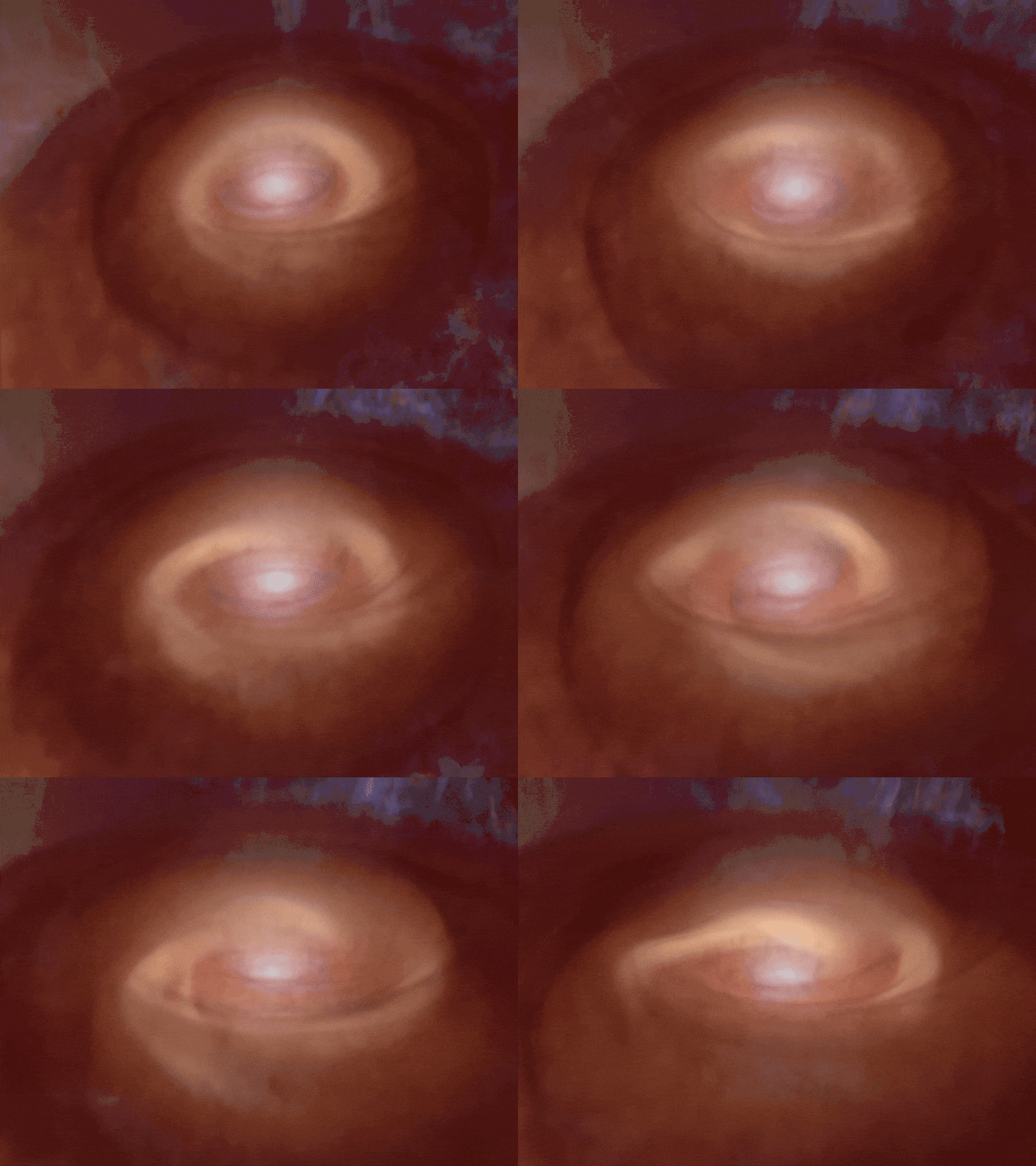
- Image credit : A graphic impression of quarks and gluons inside the proton – Dominguez, Daniel – CERN-HOMEWEB-PHO-2019-065
Leave a Reply