
In February 1997, Stephen Hawking and Kip Thorne signed a formal wager with John Preskill at the California Institute of Technology. The stakes were an encyclopaedia of the winner’s choice. The question the bet turned on was this: when a black hole forms from collapsing matter and then evaporates by emitting radiation, is the information about what fell in preserved or destroyed?
Hawking and Thorne argued that since general relativity made it impossible for black holes to radiate and lose information, the mass-energy and information carried by Hawking radiation must be new and must not originate from inside the black hole event horizon. Since this contradicted the idea of microcausality in quantum mechanics, quantum mechanics would need to be rewritten. Preskill argued the opposite: that since quantum mechanics suggests the information emitted by a black hole relates to information that fell in at an earlier time, the view of black holes given by general relativity must be modified in some way.
In 2004, Hawking conceded. He presented Preskill with a baseball encyclopaedia, noting that information could be retrieved from it at will. Thorne declined to concede, arguing that Hawking’s model of fluctuating event horizons did not convincingly restore full unitarity in quantum mechanics for processes involving black hole formation and evaporation. Thorne stated that while the argument appeared promising, he required a detailed paper to evaluate its rigour, emphasising that the proposal addressed only partial aspects of the paradox and left open questions about how information could be consistently preserved without violating established quantum principles.
Hawking’s concession was motivated by new theoretical arguments, not by a proof. The question of what happens to information in a black hole remains one of the deepest and most contested problems in theoretical physics.
What Information Means in Physics
In quantum mechanics, the state of a physical system is described by a mathematical object called a wavefunction. The wavefunction encodes everything that can be known about the system — its energy, position, spin, and all other physical properties. The Schrödinger equation, which governs how the wavefunction evolves over time, is reversible. Given the wavefunction at any moment, it can be run forward or backward to reconstruct the state at any other moment. No information is lost.
This reversibility is called unitarity. A quantum mechanical evolution is unitary if it preserves the total probability of all outcomes — the probabilities of all possible outcomes always sum to one — and if it is invertible. Unitarity is not merely a technical property. It is the mathematical expression of the principle that information is conserved in quantum mechanics. If the evolution of a quantum system is unitary, the information about its initial state is always present in its final state, even if it has been scrambled beyond any practical recovery.
Unitarity has never been violated in any quantum mechanical experiment or observation. It is one of the foundational pillars of quantum mechanics, as fundamental to the theory as the Schrödinger equation itself.
Hawking Radiation: Why Black Holes Are Not Black
The paradox arises from Hawking’s 1974 discovery that black holes are not entirely black. Understanding why requires understanding what the quantum vacuum actually is.
In classical physics, the vacuum is empty. In quantum field theory, it is not. The vacuum is filled with quantum fluctuations. Quantum fluctuations describe how empty space is actually a bubbling sea of energy. The Heisenberg uncertainty principle allows temporary energy variations in the vacuum, producing quantum fluctuations whose effects are measurable.

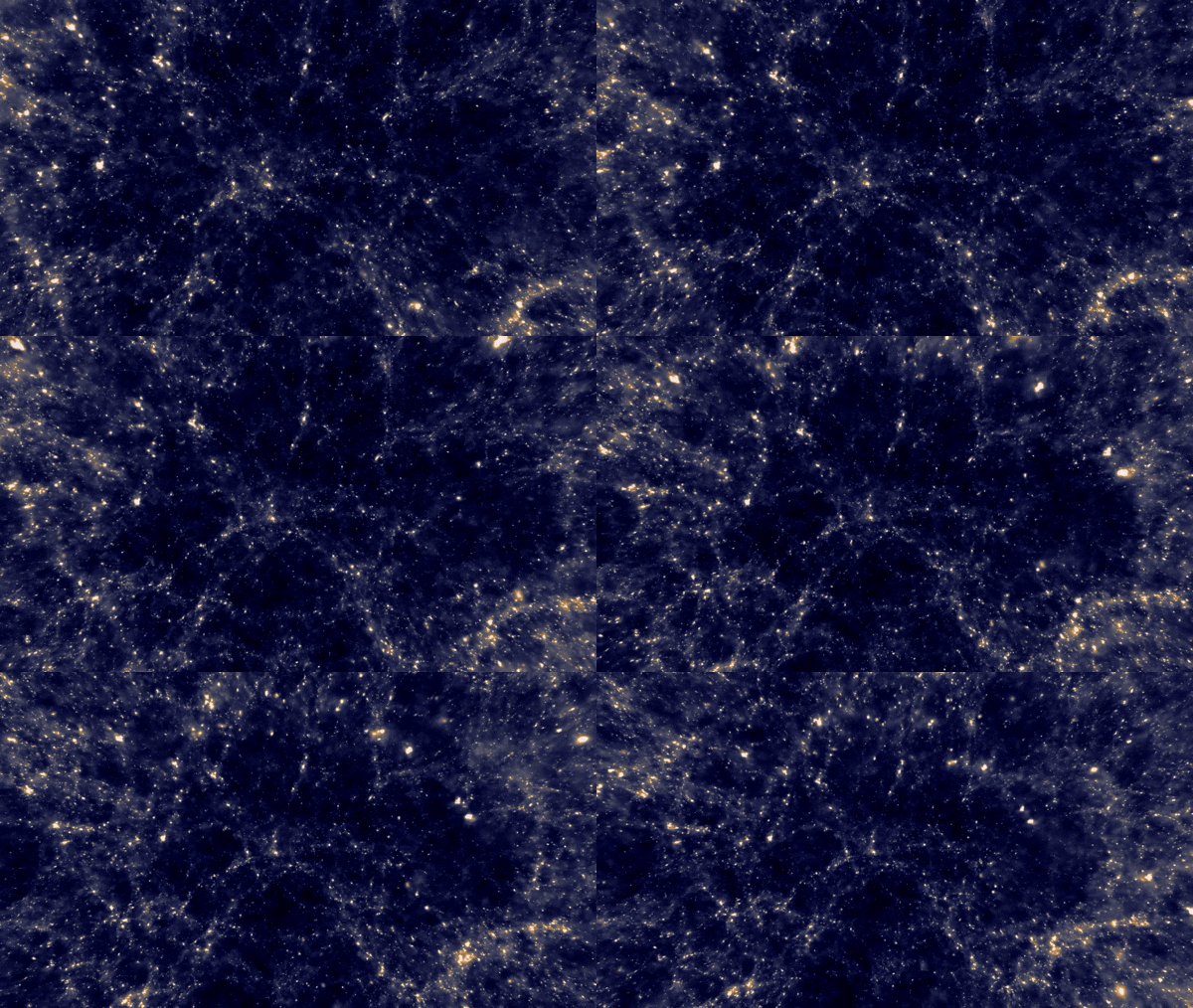
Credit: Derek Leinweber
The fundamental relationship governing these fluctuations relies on the time-energy uncertainty relation, expressed mathematically as:
Here, (h-bar) represents the reduced Planck constant—a fundamental value setting the scale of quantum mechanics. This formula dictates the lifetime of the fluctuation: the more energy () spontaneously borrowed to create a virtual particle pair, the less time () it has to exist before vanishing back into the vacuum.
These fluctuations are not real particles. They cannot be directly detected. They are a consequence of the mathematical structure of quantum fields and have measurable indirect effects.
Crucially, what qualifies as a vacuum state is not an absolute cosmic baseline; it depends entirely on the frame of the observer. In flat spacetime, all inertial observers agree on what constitutes the vacuum state—the total absence of real particles. In curved space-time, however, observers at different positions moving with different accelerations fundamentally disagree.
For instance, an observer far from a black hole and an observer near the event horizon define the vacuum differently. The observer close to the event horizon is in a state of local free-fall (where the gravitational acceleration is locally un-felt) whereas the observer far away remains at rest relative to the black hole’s frame. Because these two vantage points establish distinct mathematical bases for defining what a “particle” and a “vacuum” are, converting between their quantum states forces the observer at infinity to perceive the near-horizon vacuum fluctuations not as empty space but as a net thermal flux of real, escaping particles known as Hawking radiation.

Credit: Physics Feed
The intuitive picture of particle-antiparticle pairs appearing at the horizon, with one falling in and one escaping, was popularised by Hawking himself in A Brief History of Time. It is not what the physics describes. The actual derivation does not involve local events at the horizon. The radiation arises from the mismatch between how different observers in curved spacetime define the vacuum state. What appears as empty space to an observer near the horizon appears as a thermal bath of real particles to an observer far away. The observer at infinity detects this as outgoing thermal radiation* carrying energy away from the black hole.

Credit: E. Siegel
The temperature of this radiation is inversely proportional to the mass of the black hole. For a black hole of stellar mass, the temperature is approximately 10⁻⁷ Kelvin — far colder than the cosmic microwave background. Such a black hole absorbs more radiation from the universe than it emits and will not evaporate on any observable timescale.
Hawking radiation has not been directly detected from an astrophysical black hole. But the theoretical derivation is robust, and its existence is accepted by the vast majority of physicists.
The Paradox
The crisis occurs when one analyses the full life cycle of this evaporation through Hawking’s semi-classical lens. Suppose a black hole is formed from matter in a perfectly known, pure quantum state (). As it evaporates, it emits Hawking radiation. Hawking’s original calculation showed that this radiation is strictly thermal and featureless, its spectrum dictated solely by macroscopic parameters: mass, charge, and spin. It carries absolutely no subtle quantum correlations from the matter that formed the interior.
When the black hole reaches the end of its lifespan and vanishes completely, the only remnant left in the universe is this featureless thermal radiation. This final state is a mixed state—a statistical ensemble characterised by a fundamental loss of quantum information.
This creates a mathematical contradiction:
- Many-to-One Mapping: Countless different configurations of initial pure states (a star made of hydrogen, a star made of iron) would all evolve into the exact same identical, featureless thermal state.
- Irreversibility: Because the final state contains no trace of the initial state’s unique configuration, the process is fundamentally irreversible. The history of the system cannot be mathematically integrated backward.
This many-to-one mapping cannot be described by a unitary matrix. If Hawking’s semi-classical approximation is completely accurate, then the evaporation of a black hole destroys information, violates unitarity, and forces the foundational framework of quantum mechanics to break down.
Physicists are therefore left with two possibilities: either unitarity is violated and quantum mechanics breaks down in the presence of strong gravitational fields, or Hawking’s calculation is incomplete and the radiation encodes information in correlations too subtle to appear in the semi-classical approximation.
Next, we need to understand what exactly must happen to the entropy if unitarity holds? what must be sacrificed if unitarity is correct?
The Page Curve
In 1993, Don Page, a physicist and former student of Hawking, asked exactly this question: if the evaporation of a black hole is unitary, what must the entropy of the radiation look like at every moment of the process?
Consider the black hole and its radiation as a quantum system initially in a pure state with zero entropy and maximum information. As the black hole evaporates, it emits radiation. If the process is unitary, the total system of black hole plus radiation always remains in a pure state. The entropy of the radiation, considered alone, initially increases as the black hole emits more and more quanta. But at a specific moment called the Page time — which occurs when approximately half the black hole’s entropy has been emitted — the entropy of the radiation must begin to decrease. By the time the black hole has completely evaporated, the radiation alone must again be in a pure state with zero entropy. All the information that fell into the black hole must have been transferred to the radiation.
Plotted on a graph with entanglement entropy on the vertical axis and time on the horizontal axis, this behaviour produces a curve that rises from zero, reaches a peak at the Page time, and then falls back to zero as the evaporation completes. This is the Page curve. The graph also shows that the Page time occurs precisely when the rising entanglement entropy meets the shrinking thermodynamic entropy of the black hole.
Hawking’s original calculation gives a different result. The entropy of the radiation rises monotonically throughout the evaporation and ends at a high entropy value corresponding to a completely mixed state. The curve never turns around. The information is never returned.
The difference between the Page curve and Hawking’s increasing curve is the precise mathematical statement of the black hole information paradox.

The Page curve (solid purple) shows the entropy of Hawking radiation rising to a peak at the Page time, then falling back toward zero as the evaporation completes — the behaviour unitarity requires. The blue dashed line shows Hawking’s original prediction: entropy rising monotonically and never returning, corresponding to information destruction. The green dashed line shows the shrinking thermodynamic entropy of the black hole itself.
The Page time is where the two curves intersect.
The Firewall Argument
For several years following Hawking’s concession, the physics community leaned heavily on an idea called black hole complementarity. This proposal suggested that information is simultaneously reflected at the horizon (encoded in radiation for an outside observer) and passed through the horizon (carried by the infalling matter)—but because no single observer can ever be inside and outside at the same time, the two copies can never be compared, avoiding any violation of quantum cloning laws.
In 2012, Ahmed Almheiri, Donald Marolf, Joseph Polchinski, and James Sully (AMPS) proved that complementarity fails due to a rigid rule in quantum mechanics known as the monogamy of entanglement. This rule dictates that a quantum system can be maximally entangled with only one other system at a time.
The AMPS argument exposed a precise trilemma. To yield the unitary Page curve, a late-time Hawking particle (Particle B) must be maximally entangled with the early radiation far away (Particle C). However, for an observer falling through the horizon to experience a smooth, normal Einsteinian vacuum without drama, that same particle (Particle B) must also be maximally entangled with its interior partner (Particle A).
Quantum mechanics strictly forbids this three-way partnership. If we preserve unitarity and local field theory, the entanglement across the horizon between A and B must be violently broken. Severing this entanglement across an entire horizon deposits a catastrophic sheet of pure energy along the boundary. The smooth, invisible event horizon of general relativity is replaced by a violent quantum boundary: a firewall that vaporizes any infalling observer the moment they touch it.
The Island Formula
The most significant theoretical development in the information paradox since the AMPS argument is the island formula.
In the standard calculation of the entropy of Hawking radiation, only the degrees of freedom of the radiation itself — the region outside the black hole — are included. The interior is treated as causally disconnected from the exterior. This is what produces the monotonically increasing entropy curve and the apparent information destruction.
The island formula modifies this prescription. At late stages of evaporation, it becomes entropically favourable to include contributions from a specific region deep inside the black hole interior called an island.
The island is not arbitrary. The island is the region of the interior that minimises the total entropy when combined with the exterior radiation.
The physical implications of the island formula are striking. At late times, the physical degrees of freedom inside the black hole’s interior island become effectively part of the same quantum system as the radiation outside. The interior is no longer causally isolated in the quantum description. This is a direct expression of the holographic principle: the interior of the black hole is encoded on its boundary.
When the island contributions are included in the entropy calculation, the entropy of the radiation follows the Page curve. It rises to a maximum at the Page time and then decreases, reaching zero when the black hole has completely evaporated. Unitarity is restored.
Whether the island formula applies to realistic four-dimensional black holes in our universe has not been established. More importantly, the island formula tells us that the entropy must follow the Page curve without explaining the physical mechanism by which information escapes from the black hole interior into the radiation. It establishes that unitarity is restored, not how it is restored. This is precisely why Thorne has not conceded and why Preskill accepted his encyclopaedia with reluctance.
The Deeper Conflict
The black hole information paradox is, at its core, a conflict between two frameworks.
General relativity describes the geometry of spacetime and predicts event horizons that are one-way surfaces. Whatever crosses an event horizon is causally disconnected from the external universe. The information cannot get out because nothing can get out. This is not a limitation of measurement. It is a consequence of the causal structure of spacetime as general relativity describes it.
Quantum mechanics describes the evolution of physical systems and requires that evolution to be unitary. If a black hole forms and evaporates as a quantum mechanical system, the information about its initial state must be present in its final state, even if that state is the Hawking radiation.
These two requirements are incompatible given the current frameworks of both theories. Resolving the contradiction requires either a modification of the causal structure of spacetime near black holes, a modification of the semi-classical calculation of Hawking radiation, or a new framework that reconciles both. The island formula represents progress of the second kind. The firewall argument clarified that the first kind of modification may be unavoidable.
What the information paradox has established is that a consistent description of black hole evaporation requires a quantum theory of gravity. Not as a technical refinement but as a fundamental necessity. The semi-classical framework — quantum fields on a fixed classical spacetime — breaks down at the latest by the Page time. Whatever replaces it is the subject of the remaining articles in this series.
What Observation Can Say
Hawking radiation has not been directly detected from an astrophysical black hole. For any black hole of stellar or supermassive mass, the temperature is far below the cosmic microwave background, making the signal undetectable against the noise of the universe.
In 2019, Jeff Steinhauer and collaborators reported the first observation of thermal, spontaneous Hawking radiation in a sonic analogue black hole — a flowing fluid system that mimics the mathematical structure of a black hole horizon.

Credit: Jeff Steinhauer et al.
The result is consistent with the theoretical prediction. It provides experimental support for the mechanism of Hawking radiation but does not directly probe the information paradox, because the analogue system has a well-defined microscopic description in which information is preserved by construction.
Gravitational wave observations from LIGO and Virgo offer an indirect test. If the firewall proposal is correct and the horizon is a violent quantum boundary, this should leave an imprint on the ringdown spectrum of a black hole merger in the form of gravitational wave echoes — secondary bursts arriving after the main ringdown signal. Searches for such echoes in LIGO and Virgo data have found no statistically significant evidence. The absence of echoes constrains but does not rule out the firewall. The no-firewall scenario, in which information escapes by some other mechanism and the horizon remains smooth, is consistent with current observations.

A schematic diagram illustrating how a near-horizon quantum structure traps gravitational perturbations. The peak of the angular momentum barrier (the photon sphere) and a Planck-scale reflective boundary (such as a firewall) form an effective cosmic cavity. Ingoing wave modes reflect off the quantum horizon and bounce back toward the potential barrier, partially transmitting out to infinity at fixed intervals () as repeating, damped gravitational wave echoes.
Credit: Abedi et al.
The Event Horizon Telescope images of M87* and Sagittarius A* are consistent with classical general relativity. The precision required to detect quantum corrections to the horizon structure is several orders of magnitude beyond current capabilities.

Credit: ETH Collaboration
Further readings:
- Featured image credit: Jörn Wilms (Tübingen), NASA, ESA
- https://backreaction.blogspot.com/2015/12/hawking-radiation-is-not-produced-at.html
- https://bigthink.com/starts-with-a-bang/hawking-radiation-black-holes/
- https://www.forbes.com/sites/startswithabang/2018/11/03/ask-ethan-how-do-black-holes-actually-evaporate/?sh=56ee44ed24a1
- Don N Page 2005 New J. Phys. 7 203
DOI 10.1088/1367-2630/7/1/203 - https://science.nasa.gov/universe/black-holes/anatomy/
- https://shmaesphysics.wordpress.com/2022/12/03/a-better-quantum-extremal-surface-and-island-interpretation-that-explains-the-associated-massive-gravity/
- Observation of stationary spontaneous Hawking radiation and the time evolution of an analogue black hole
- Is the Gravitational-Wave Ringdown a Probe of the Event Horizon?
- Echoes from the Abyss: Tentative evidence for Planck-scale structure at black hole horizons
- Ask Ethan: Do Virtual Particles Really Exist?
This is Article X of The Geometry of Reality and the fourth article of Group 3.
Leave a Reply