
The three articles of Group 1 established the problem. General relativity and quantum mechanics are incompatible at the Planck scale. Quantum mechanics itself contains an unresolved gap in its foundations. Applying quantum field theory to gravity produces uncontrollable infinities that cannot be removed by any known mathematical procedure. The general relativity describes gravity as the geometry of spacetime itself, and quantising geometry is a fundamentally different task from quantising a field that exists within a pre-given spacetime.
Group 2 examines the three serious theoretical attempts to resolve this incompatibility. This article examines the first attempt, loop quantum gravity.
Loop quantum gravity begins with a deceptively simple premise. If gravity is geometry, and geometry must be quantised, then quantise geometry directly. Do not introduce extra dimensions. Do not replace particles with strings. Do not abandon general relativity’s core insight that spacetime is a dynamical entity rather than a fixed background. Start from general relativity as it is, apply the principles of quantum mechanics to it as faithfully as possible, and see what emerges.
What emerges is a picture of space as a discrete quantum structure — not a smooth continuum but a network of finite, countable, quantised pieces. Whether this picture is correct is not yet known. But it is mathematically well-defined, makes concrete predictions, and has been developed over nearly four decades into one of the most sophisticated approaches to quantum gravity that exists.
The Starting Point
In 1986, Abhay Ashtekar published a paper in Physical Review Letters that reformulated the equations of general relativity in an unexpected way.
General relativity had been formulated by Einstein in terms of the metric tensor†. The metric is the natural language for describing curved geometry, and Einstein’s field equations describe how the metric responds to the distribution of mass and energy. Quantising the metric directly had been attempted since the 1950s. The attempts ran into the non-renormalisability problem and the progress stalled.
Ashtekar’s insight was that general relativity could be rewritten in a different set of variables that resembled the mathematical structure of the other successful quantum field theories. Instead of the metric, Ashtekar used Ashtekar variables or the Ashtekar-Barbero connection†and a related quantity called the densitised triad†.
Analogy: If you imagine space as a fabric, the connection tells you how it is bent, while the densitised triad tells you exactly how much material (area) exists in a specific region.
In this reformulation, general relativity looked like a gauge theory, with a mathematical structure similar to quantum chromodynamics.
This reformulation mattered because gauge theories are the framework in which the Standard Model was built. The tools of quantisation developed for electrodynamics and the strong force could, in principle, be adapted for gravity.
Shortly after this reformulation, Ted Jacobson and Lee Smolin discovered that the central equation of quantum gravity, ‘the Wheeler-DeWitt equation’ – the quantum analogue of Einstein’s field equations, admitted exact solutions in terms of loops. Specifically, the traces of the holonomies† of the Ashtekar connection along smooth, non-self-intersecting loops solved the equation. The discovery of these loop solutions gave the theory its name and its initial direction.
Carlo Rovelli and Lee Smolin then used these loop solutions as the basis states for the Hilbert space of quantum gravity. Instead of describing quantum states of the gravitational field as wave functions of the metric, they described them as functions of loops in space. In their 1988 paper Knot Theory and Quantum Gravity, Rovelli and Smolin defined a non-perturbative and background-independent quantum theory of gravity. Space was no longer a stage; it was itself a dynamic entity, woven from loops.
Spin Networks
The loop states of the early theory were an important beginning, but they had technical problems. Jorge Pullin and Jerzy Lewandowski recognised that intersecting loops were essential for consistency, and the theory needed a richer mathematical structure to handle them.
The resolution came through spin networks, a concept originally introduced by the physicist Roger Penrose in the 1970s as a combinatorial approach to describing the structure of space without reference to any background geometry.
In the context of loop quantum gravity, spin networks are graphs whose edges are labelled by representations of the mathematical group SU(2)+, and whose nodes are labelled by intertwining operators that determine how the edges connect.
A spin network is not a picture of loops in space. It is a quantum state of space itself. Each edge of the spin network carries a quantum number that determines the area of any surface that edge crosses. Each node determines the volume of the spatial region associated with it. The geometry of space, its areas and volumes, is encoded entirely in the combinatorial structure of the spin network.
This is a radical departure from classical physics. In general relativity, space is a smooth manifold, a continuous entity described by real-valued coordinates. In loop quantum gravity, at the fundamental level, there is no smooth manifold. There is a discrete and a combinatorial structure, the spin network, that is not embedded in any pre-existing space. The continuous geometry of general relativity is expected to emerge from spin networks in the same way that the smoothness of a fabric emerges from discrete interwoven threads when viewed from a sufficient distance.
The Discrete Spectra of Area and Volume
The most concrete and testable result of loop quantum gravity is the prediction that the operators corresponding to area and volume have discrete spectra. This was proved by Rovelli and Smolin in 1994 and 1995, and it is the clearest sense in which LQG predicts that spacetime is not continuous.
In quantum mechanics, an observable has a discrete spectrum if its possible measured values form a countable set rather than a continuous range. The energy levels of a hydrogen atom are a familiar example: an electron can have energy of exactly this value or exactly that value, but not any value in between. Loop quantum gravity predicts the same discreteness for geometry itself.
The area of a surface in loop quantum gravity is quantised. Each edge of a spin network that crosses the surface contributes a discrete amount to its area, proportional to the square root of a combination of the edge’s spin quantum number and a constant called the Immirzi parameter. The smallest non-zero area that any surface can have is on the order of the Planck area — the Planck length squared. Below this scale, the concept of area loses physical meaning. In a precise quantum mechanical sense, the fabric of space is not smooth but granular.
Volume is similarly quantised. Each node of a spin network contributes a discrete quantum of volume, on the order of the Planck volume. The smallest possible volume is on the order of the Planck length cubed.
These are quantitative statements about the spectrum of geometric observables that differ from classical general relativity. They emerge naturally from the quantum theory and provide a precise mathematical realisation of the intuition that spacetime at the Planck scale is not continuous. Discreteness emerges as a standard quantum effect from the discrete spectra, and provides a mathematical realisation of Wheeler’s spacetime foam intuition.
The Spin Foams
The results described so far concern the kinematics of loop quantum gravity and the description of quantum states of space at a fixed moment of time. The spin foams describe the dynamics of the theory and how these states evolve.
A spin foam is the four-dimensional extension of a spin network. If a spin network describes a quantum state of space at one moment, a spin foam describes the history of space from one moment to another. The edges of a spin network sweep out two-dimensional surfaces, and the nodes sweep out edges, generating a foam-like structure in four-dimensional spacetime. The quantum amplitude for a transition between two spin network states is computed by summing over all spin foams connecting them, in analogy to the Feynman path integral of ordinary quantum mechanics.

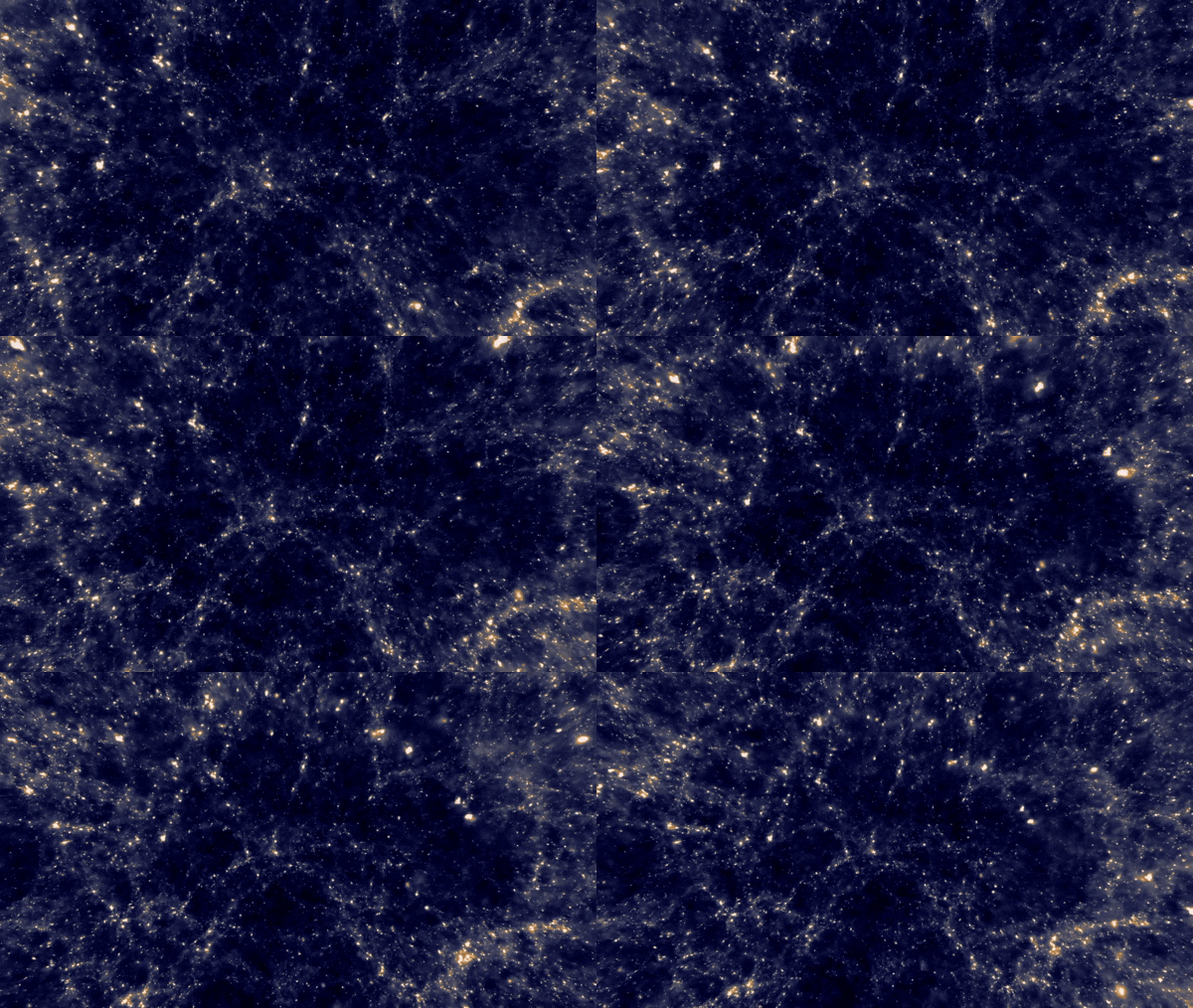
(Credit: Illustration: NASA/CXC/M.Weiss)
The present version of the covariant dynamics is known as the EPRL model, developed from 2007 onward by Engle, Pereira, Rovelli, Livine, Freidel, and Krasnov. The EPRL spin foam amplitudes have better mathematical properties than earlier proposals and represent the current standard for calculations in the covariant formulation of the theory.
Computing spin foam amplitudes is technically extremely demanding. In 1985, Goroff and Sagnotti demonstrated non-renormalisability with a two-loop calculation that required significant computational resources. In loop quantum gravity, spin foam calculations involve sums over infinitely many configurations and have resisted analytical treatment in all but the simplest cases. Applying high-performance computing and even machine learning to spin foam amplitudes are an active research area.
This year, 2026, will mark the 40th anniversary of Ashtekar’s new variables and complete calculations of the graph-changing dynamics are only now becoming feasible.
The Big Bounce
The most striking application of loop quantum gravity’s ideas is the resolution of cosmological singularities in loop quantum cosmology, a symmetry-reduced version of LQG applied to homogeneous and isotropic spacetimes.
Classical general relativity, applied to an expanding universe traced backward in time, inevitably reaches the Big Bang singularity — a point of infinite density and infinite spacetime curvature at a finite time in the past. Within classical general relativity, the concept of spacetime has no meaning before this singularity. The theory breaks down, and physics cannot say what, if anything, preceded it.
In loop quantum cosmology, the fundamental discreteness of quantum geometry creates a new repulsive force that is negligible at low densities but becomes dominant as densities approach the Planck scale. This quantum gravitational repulsion overwhelms the classical gravitational attraction, preventing the collapse to a singularity. Instead of a Big Bang singularity, loop quantum cosmology predicts a Big Bounce where the universe contracts to a maximum density of order the Planck density, approximately 10⁹⁶ kilograms per cubic metre, and then rebounds into expansion.
Due to the fundamental discreteness of quantum geometry, the big bang singularity has been shown to be replaced by a big bounce. This result has been confirmed in numerical simulations and holds across a wide range of cosmological models including anisotropic spacetimes.

The Big Bounce is a genuine prediction of loop quantum cosmology that differs from classical general relativity in a way that is, in principle, observable. If the pre-bounce contracting phase left imprints on the cosmic microwave background — anomalies at large angular scales, modifications to the primordial power spectrum — these could in principle be detected by sufficiently sensitive observations. Current CMB data, including the Planck satellite’s final results, are consistent with loop quantum cosmology’s predictions at large scales, though the statistical significance is insufficient to claim confirmation.
Black Hole Entropy
A second concrete result of loop quantum gravity is the derivation of the Bekenstein-Hawking formula for black hole entropy.
In 1973, Jacob Bekenstein proposed that black holes carry entropy proportional to their surface area — the area of the event horizon. In 1974, Stephen Hawking confirmed this and derived the precise formula— the entropy of a black hole is equal to one quarter of the area of its event horizon, measured in Planck units. This formula is one of the most remarkable results in theoretical physics, connecting thermodynamics, quantum mechanics, and gravity. But its derivation is semi-classical — it treats quantum fields on a fixed classical black hole background rather than treating the geometry itself as quantum.
Loop quantum gravity provides a microscopic derivation of the Bekenstein-Hawking formula from the structure of quantum geometry. Each point where a spin network edge crosses the black hole horizon carries a discrete quantum of area. The entropy of the black hole is the logarithm of the number of distinct spin network configurations that give rise to the same macroscopic horizon area, in direct analogy to how thermodynamic entropy counts microstates in statistical mechanics.
For black holes, loop quantum gravity derives the Bekenstein-Hawking entropy formula directly from fundamental theory. Quantum geometries puncture the horizon at points, each carrying quantised area. The calculation reproduces the Bekenstein-Hawking formula up to a constant involving the Immirzi parameter, which must be fixed by requiring agreement with the semi-classical result. This is not a free parameter in the sense of string theory’s landscape: once fixed by the black hole entropy calculation, the Immirzi parameter determines the minimum area eigenvalue and other geometric predictions of the theory.
The Semi-classical Limit
Despite these achievements, loop quantum gravity faces a central unresolved problem. It has not yet been demonstrated that the smooth spacetime of classical general relativity correctly emerges from the theory at large scales. This is the semi-classical limit.
Any correct quantum theory of gravity must reproduce the predictions of Einstein’s general relativity. This is not guaranteed. The discrete, combinatorial structure of spin networks at the Planck scale must give rise to the smooth Riemannian geometry that describes the curvature of spacetime at the scales where general relativity has been tested.
The fabric of a cloth is analogous: at a distance it is a smooth curved two-dimensional surface, but on closer inspection we see that it is actually composed of thousands of one-dimensional linked threads. The image of space given in loop quantum gravity is similar. At large scales, a large spin network formed by an enormous number of nodes and links should approximate a smooth spatial geometry. But rigorously proving that the smooth geometry of general relativity, with its specific equations of motion, is recovered in this limit has not been achieved.
Loop quantum gravity is not yet a complete theory, nor has its full consistency with classical general relativity been rigorously established. LQG has a mathematically well-defined kinematic framework. What it lacks is proof that its dynamics reduces to Einstein’s equations in the appropriate limit. Until this is demonstrated, the theory remains a compelling candidate for quantum gravity rather than an established successor to general relativity.
Background Independence
One feature of loop quantum gravity deserves emphasis because it distinguishes the theory sharply from string theory.
Spacetime as a container over which physics takes place has no objective physical meaning in LQG. Instead, the gravitational interaction is represented as one of the fields forming the world, and the physical states of the theory remain invariant under arbitrary rearrangements of the spatial coordinates — a property called diffeomorphism invariance, which is the gauge symmetry of general relativity.
This background independence means that loop quantum gravity does not require a fixed spacetime to be specified before the theory can be formulated. String theory in its standard perturbative formulation does require such a background. Loop quantum gravity’s advocates argue that this makes LQG more faithful to general relativity’s core conceptual lesson: there is no spacetime stage. There is only the relational structure of physical interactions.
Whether background independence is a virtue or a limitation depends on one’s perspective. It makes the mathematics of loop quantum gravity harder — without a fixed background, standard tools of quantum field theory become difficult to apply. It also makes certain questions, such as the scattering of particles at low energies, harder to compute. String theory’s background dependence makes these calculations easier, which is one reason string theory has been more productive in connecting to particle physics phenomenology.
Where The Theory Stands
Loop quantum gravity is a mathematically well-defined, non-perturbative and background-independent approach to quantum gravity that has been under active development since the late 1980s. Its achievements include the quantisation of area and volume, the derivation of black hole entropy, the prediction of the Big Bounce in loop quantum cosmology, and the development of spin foam dynamics. Many research groups worldwide work on various aspects of the theory.
Its unresolved problems are also clear. It has not yet proved that classical general relativity emerges correctly at large scales. It has not produced confirmed experimental predictions. The dynamics remains unsettled, with several competing formulations. And the problem of time, how to define time evolution in a background-independent theory, remains philosophically and technically difficult.
We still do not know if this theory is physically correct. Direct or indirect experimental corroboration is lacking. This is the case for all present approaches to quantum gravity, due to the minuteness of the scale at which quantum properties of spacetime presumably manifest themselves.
The honest assessment is that loop quantum gravity has made more progress on quantising geometry directly than any other approach, and has encountered serious difficulties in demonstrating that the quantisation produces correct low-energy physics.
Further Readings
- Featured image credit: Artist representation of a black hole. The bottom half of the image depicts the black hole which, according to general relativity, traps everything including light. Effects based on loop quantum gravity, a theory that extends Einstein’s general relativity using quantum mechanics, overcome this tremendous pull and liberate everything (top half of image), thus providing a concrete avenue for recovery of information previously thought to be lost in the black hole singularity. Credit: A. Corichi and J. P. Ruiz
- New variables for classical and quantum gravity
- Knot theory and quantum gravity
- Discreteness of area and volume in quantum gravity
- Spin networks and quantum gravity
- Spinfoams and High-Performance Computing
- Black hole entropy
- Absence of Singularity in Loop Quantum Cosmology
- Loop Quantum Cosmology: Physics of Singularity Resolution and its Implications
- The loop-quantum-gravity vertex-amplitude
- https://plato.stanford.edu/entries/quantum-gravity/
Leave a Reply