
String theory did not begin as a theory of gravity. It began as a theory of the strong nuclear force, and it began with an accident.
In 1968, physicist Gabriele Veneziano was searching for a mathematical formula that could describe how hadrons† scatter off each other at high energies. He noticed that a known mathematical function, the Euler beta function†, matched the experimental data remarkably well. The formula worked, but no one knew why.
Within a few years, physicists including Yoichiro Nambu, Holger Bech Nielsen, and Leonard Susskind provided the physical interpretation: the Veneziano formula was describing the quantum mechanics of a vibrating one-dimensional string. The scattering of hadrons could be modelled as the interaction of strings.
The string model of hadrons had problems from the start. It required the strings to live in twenty-six dimensions of spacetime, not four. It predicted a particle with properties no hadron possessed, a massless particle with spin 2†. And in 1973, quantum chromodynamics arrived and provided a far better description of the strong force. Almost everyone abandoned strings.
Two physicists who did not abandon them were John Schwarz and Joël Scherk. In 1974, they made a decision that reframed the entire program. The troublesome massless spin-2 particle, they argued, was not a problem. It was the graviton. String theory was not a theory of the strong force. It was a theory of gravity.
The idea was ignored for nearly a decade. String theory in this new guise required ten dimensions, not four, and had no obvious connection to the physics of the known world. But a small number of researchers continued developing it, and in 1984 the situation changed decisively.
The First Superstring Revolution: 1984
The event that transformed string theory from a marginal curiosity into the dominant program in theoretical physics was a calculation completed by Michael Green and John Schwarz in the summer of 1984.
Quantum field theories can suffer from mathematical anomalies that arise when quantum corrections violate symmetries that the classical theory possesses. Anomalies destroy the internal consistency of a theory and render it physically meaningless. It had been suspected that superstring theories†would be plagued by such anomalies and therefore inconsistent.
Green and Schwarz showed that in a specific version of superstring theory, with a specific gauge group†, the anomalies cancelled exactly. The theory was internally consistent. The news reached Edward Witten, then the most influential theoretical physicist in the world, and his response was immediate and decisive. Within weeks he had convinced himself that string theory was a viable, consistent unified theory of all fundamental forces, and his endorsement brought hundreds of physicists into the field. By 1985, the first superstring revolution was underway.
In 1985, Candelas, Horowitz, Strominger, and Witten showed that compactifying the six extra dimensions of the ten-dimensional theory on a specific class of geometric shapes — Calabi-Yau manifolds — produced theories with the right number of particle families to potentially describe the Standard Model. The program suddenly looked as though it might produce a realistic theory of everything.

The String, Its Vibrations, and the Extra Dimensions
A string in string theory is a one-dimensional object with a characteristic length at or near the Planck scale — approximately 10⁻³⁵ metres. It can be open, with two free endpoints, or closed, forming a loop. It has no internal structure. It is not made of anything smaller. It vibrates.
Different patterns of vibration correspond to different particles. The mass, spin, charge, and other quantum numbers of a particle are determined entirely by which vibrational mode the string is in. There are no separate fundamental particles with separate properties inserted by hand into the theory. There is one object — the string — and all particles are different oscillation modes of that object. An electron, a photon, a quark, and a graviton are, in this context, the same kind of thing vibrating differently. The distinction between matter and force, between the particles that make up atoms and the particles that carry interactions between them, is not fundamental. It is a consequence of which mode is excited.
The closed string’s lowest-energy oscillation mode produces a massless particle with spin 2. This is not a design choice. It is a mathematical consequence of the theory’s consistency conditions. A massless spin-2 particle is precisely what a graviton must be — it is the unique type of particle consistent with mediating a long-range force that respects general covariance†. The graviton in string theory is not added to the theory. It is forced upon it by the mathematics.
When physicists apply quantum mechanics to the string, they find that the theory is mathematically consistent only in a specific number of spacetime dimensions. For bosonic string theory this is twenty-six. For superstring theory — string theory incorporating supersymmetry — it is ten. In fewer dimensions the theory develops anomalies in the quantum commutation relations †that break Lorentz invariance† and render the theory meaningless. The extra dimensions are demanded by the internal consistency of the quantum theory.
Ten dimensions of spacetime must reduce to the four we observe. The standard mechanism is compactification: the six extra spatial dimensions are curled up into a compact geometric shape at every point in the four visible dimensions. The shape is too small to observe directly — its scale is at or near the Planck length.
The specific geometry of this compact space determines the low-energy physics that emerges in four dimensions: the particle masses, coupling constants†, and symmetry structure of the resulting theory. Different compact geometries produce different four-dimensional physics. This is the origin of the landscape problem, which is examined later in this article.
Supersymmetry and Its Absence at the LHC
Superstring theory requires supersymmetry — a proposed mathematical symmetry between the two fundamental classes of particles. Bosons are force-carrying particles: photons, gluons, the W and Z bosons of the weak force. Fermions are matter particles: electrons, quarks, neutrinos. In an ordinary quantum field theory, bosons and fermions are entirely distinct. Supersymmetry proposes that for every known boson there exists a fermionic partner, and for every known fermion there exists a bosonic partner. The electron’s partner is the selectron. The quark’s partner is the squark. The photon’s partner is the photino. None of these particles has ever been observed.
Supersymmetry is required in superstring theory for two reasons. First, without it the bosonic string theory contains tachyons †— particles with imaginary mass that signal an instability in the vacuum, rendering the theory physically meaningless. Supersymmetry eliminates the tachyon and produces a stable, consistent spectrum of particles. Second, the cancellation of anomalies that Green and Schwarz demonstrated in 1984 depends on supersymmetry. Remove supersymmetry and the anomaly cancellation fails.
Beyond its role in string theory, supersymmetry was attractive because it appeared to solve the hierarchy problem — the question of why the Higgs boson mass is so much smaller than the Planck mass, given that quantum corrections would naturally push it toward the Planck scale unless those corrections cancel with extraordinary precision. Supersymmetric partner particles would provide the cancellation naturally, stabilising the Higgs mass without fine-tuning.
The Large Hadron Collider (LHC) at CERN was the most powerful instrument ever built for testing these predictions. If supersymmetric partner particles exist at the energy scales most theorists expected — the TeV scale — they would have been produced in LHC collisions and detected. After more than a decade of operation and analysis of trillions of collision events, no supersymmetric partner particle has been found. This does not rule out supersymmetry entirely — the partner particles could exist at higher energies than the LHC can reach — but it eliminates the parameter space that most naturally solved the hierarchy problem. The failure to find supersymmetry at the LHC is the most direct experimental challenge string theory has faced.
M-Theory and the Second Revolution: 1995
Five distinct but mathematically consistent superstring theories had emerged by the early 1990s. This proliferation of theories was itself a problem: if string theory was the unique correct theory of everything, why were there five of them?
The resolution came in 1995, when Witten presented a proposal at a string theory conference in California. He argued that the five superstring theories were not five different theories. They were five different limiting cases of a single eleven-dimensional theory, which he called M-theory.
The evidence for this unification came from a set of mathematical relationships called dualities. Duality, in this context, means that two theories that appear completely different in their formulation produce identical physical predictions. A strong coupling constant in one theory corresponds to a weak coupling constant in another, which means the perturbative approximations that work in one theory can be translated into statements about the other. Witten and collaborators showed that all five superstring theories were connected by such dualities, and that they all arose as limiting cases of M-theory in various regimes.
M-theory introduced a further ingredient, higher-dimensional objects called branes. String theory had one-dimensional strings. M-theory had two-dimensional membranes, three-dimensional objects, and more generally p-dimensional objects called p-branes. The year before Witten’s proposal, Joseph Polchinski had shown that string theory required a specific class of these higher-dimensional objects — D-branes — on which open strings could end. D-branes turned out to be far more than a technical addition. They became the key to some of string theory’s most important results.
Black Hole Entropy
In 1996, Andrew Strominger and Cumrun Vafa used D-branes to perform a calculation that represented the most concrete success string theory had produced to that point.
As discussed in Article IV, the Bekenstein-Hawking formula states that a black hole’s entropy is proportional to the area of its event horizon in Planck units.
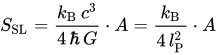
the entropy of the black hole and A the surface of the event horizon. Furthermore, the Boltzmann constant, the speed of light, the reduced Planck constant, the gravitational constant and the Planck length. In the literature, the Boltzmann constant is often omitted or set.
This formula connects thermodynamics, quantum mechanics, and gravity in a single equation. Its derivation by Hawking was semi-classical — it treated quantum fields on a fixed classical black hole background rather than treating the black hole’s geometry quantum mechanically. The microscopic origin of the entropy, the question of what quantum states were being counted, remained unexplained.
Strominger and Vafa showed that for a specific class of extremal black holes† — black holes carrying a large amount of charge — the entropy could be computed by counting the quantum states of a corresponding configuration of D-branes. The result agreed exactly with the Bekenstein-Hawking formula. String theory had provided, for the first time, a microscopic account of black hole entropy.
This calculation is widely regarded as one of string theory’s most significant achievements. It showed that string theory knows about black hole thermodynamics, and that the entropy formula is not merely a coincidence but reflects genuine quantum structure. The calculation was, however, limited to a specific class of highly supersymmetric black holes far from the conditions of any physically realistic black hole.

As the spin parameter a increases from 0 (a static Schwarzschild black hole) to 1.0 (an Extremal black hole), the ergosphere expands into a pumpkin-like shape and the event horizons merge. This convergence at a=1 provides the mathematical symmetry required for the Strominger-Vafa entropy calculation.
The Holographic Principle
The AdS/CFT correspondence realises a deeper conjecture about the structure of quantum gravity known as the holographic principle. The principle was first proposed by Gerard ‘t Hooft in 1993 and developed by Leonard Susskind, and it states that all the physical information contained in a volume of space can be fully encoded on the boundary surface of that region — in one fewer dimension.
The motivation for this conjecture comes from black hole thermodynamics. The Bekenstein-Hawking entropy formula states that a black hole’s entropy is proportional to the area of its event horizon, not its volume. In ordinary thermodynamics, the entropy of a system scales with its volume — a larger box contains more possible configurations of its contents. A black hole’s entropy scales with its surface area. This suggests that the number of independent degrees of freedom in a region of space containing a black hole is not determined by the volume of that region but by its boundary area. Extending this observation to spacetime more generally leads to the holographic principle: the fundamental description of physics in a region is encoded on the region’s boundary, like a three-dimensional image encoded on a two-dimensional holographic plate.
The AdS/CFT correspondence gives this conjecture a precise mathematical realisation for the first time. In the correspondence, a theory of quantum gravity in a five-dimensional spacetime is exactly equivalent to a quantum field theory with no gravity living on the four-dimensional boundary of that spacetime. The bulk gravitational degrees of freedom are entirely encoded in the boundary theory. This is holography made exact, at least in the specific setting of anti-de Sitter space. Whether the holographic principle applies to the observable universe, which has a positive rather than negative cosmological constant, remains an open question.
The AdS/CFT Correspondence
The most mathematically productive result in string theory’s history came in 1997, when Juan Maldacena proposed what has become known as the AdS/CFT correspondence.
Maldacena conjectured that string theory in a specific curved spacetime — anti-de Sitter space, a spacetime with a particular negative curvature — is exactly equivalent to a quantum field theory without gravity living on the boundary of that spacetime. The two theories describe the same physics, but in completely different languages: one is a theory of gravity in a higher-dimensional bulk spacetime, the other is a conventional quantum field theory in one fewer dimension, with no gravity at all.
This equivalence, if correct, is remarkable for several reasons. It provides a precise definition of string theory in anti-de Sitter space in terms of a well-understood quantum field theory. It realises the holographic principle — the idea that the physics of a volume of space can be encoded entirely on its boundary surface. And it provides a computational tool of considerable power: problems that are difficult in the gravitational theory become tractable in the boundary field theory, and vice versa.
Maldacena’s paper has become the most highly cited paper in the history of high energy physics, with more than twenty thousand citations. The correspondence has been applied to problems across theoretical physics, from the behaviour of the quark-gluon plasma to condensed matter systems to the black hole information paradox. It represents a genuine and lasting contribution to physics, independent of whether string theory correctly describes the fundamental structure of the world.
The AdS/CFT correspondence has one significant limitation as a theory of quantum gravity: it works in anti-de Sitter space, which has a negative cosmological constant. The observable universe has a positive cosmological constant. Extending the correspondence to de Sitter space — the spacetime relevant to our universe — has proven difficult, and no complete de Sitter version of the duality exists.
The Landscape Problem
String theory’s most serious difficulty as a candidate theory of quantum gravity is the landscape.
String theory requires six spatial dimensions beyond the four of ordinary spacetime to be compactified†. The geometry of this compactification determines the low-energy physics: the particle masses, coupling constants, and cosmological constant of the resulting four-dimensional theory. Different compactification geometries produce different low-energy physics.
The number of geometrically consistent compactifications is of order 10⁵⁰⁰ or larger. Each compactification corresponds to a distinct vacuum state of the theory with its own laws of physics. The collection of all these vacuum states is the landscape. String theory does not prefer any one of them. It does not predict which vacuum the universe is in, and therefore does not predict the specific values of the fundamental constants of nature.
The landscape represents a fundamental challenge to string theory’s claim to be a predictive theory of everything. If the theory contains 10⁵⁰⁰ possible universes, each with different physics, and provides no principle to select among them, then any observation is consistent with the theory. A theory that is consistent with any observation is not falsifiable.
One proposed response to the landscape is the multiverse. If all these vacuum states are physically realised in different regions of an inflationary multiverse, then the specific constants of our universe might be explained anthropically — they are the values compatible with the existence of observers. This is a coherent logical position, but it moves far beyond the domain of empirical science and is regarded by many physicists as an abandonment of the original program.
Background Dependence and the Contrast with Loop Quantum Gravity
String theory in its standard perturbative† formulation requires a fixed background spacetime to be specified before the theory can be written down. Strings propagate on this background. The background is not itself a dynamical object, it is chosen in advance.
This is background dependence, and it stands in direct contrast to general relativity’s core lesson and to loop quantum gravity’s approach. In general relativity, there is no fixed background. Spacetime is itself dynamic, curved and shaped by matter and energy. A complete quantum theory of gravity should inherit this background independence.
String theory’s advocates acknowledge this issue and argue that the full non-perturbative† theory — M-theory — may be background-independent, even if its perturbative formulations are not. The AdS/CFT correspondence is sometimes cited as evidence for this, since it provides a definition of the gravitational theory in terms of a boundary theory without gravity. But a truly background-independent formulation of string theory does not yet exist.
String theory’s advocates also point to a complementary strength: it correctly reproduces general relativity at low energies. At large distances and low energies, the excitations of strings behave like the particles and fields of the Standard Model and general relativity. This is not true of loop quantum gravity, which has not yet demonstrated that its dynamics reduce to Einstein’s equations in the appropriate classical limit.
The comparison between the two approaches therefore involves a genuine trade-off. String theory recovers general relativity but requires a fixed background and contains a landscape of possible universes. Loop quantum gravity is background-independent but has not proven its classical limit. Each approach succeeds where the other struggles, and each struggles where the other succeeds.
Experimental Status
String theory makes no confirmed experimental prediction that distinguishes it from the Standard Model and general relativity together. The extra dimensions it requires have not been detected. The supersymmetric partner particles it predicts, which would have been produced at the LHC if they exist at the energy scales most theorists expected, have not been found. The landscape undermines the expectation of specific predictions in any case.
This lack of experimental validation does not establish that string theory is wrong. The Planck scale is sixteen orders of magnitude beyond the reach of current accelerators. It is possible that string theory is the correct theory of quantum gravity and that we will never have direct experimental access to the energy scale at which its predictions differ from those of existing theories.
What the experimental situation does establish is that string theory’s status as a physical theory remains unconfirmed. It is a candidate theory of extraordinary mathematical richness and internal consistency, with genuine achievements in black hole physics and the AdS/CFT correspondence. Whether it correctly describes the structure of spacetime at the Planck scale is not known, and may not be knowable within the foreseeable future.
Where String Theory Stands
String theory began as an accident, was reinterpreted as a theory of gravity, was nearly abandoned, was revived by anomaly cancellation, expanded into a framework claiming to describe everything, produced concrete results on black hole entropy and the AdS/CFT correspondence, and encountered the landscape as a problem it has not resolved.
It remains an active and productive area of research. Its mathematical techniques have found applications in condensed matter physics, nuclear physics, and pure mathematics far beyond its original domain. Whether these contributions are evidence that string theory is the correct theory of quantum gravity, or evidence that it is an extraordinarily rich piece of mathematics that describes something other than the physical world, is genuinely contested.
Further Readings
- Featured image credit: Fractal Nature of the Universe
- https://demonstrations.wolfram.com/CalabiYauSpace
- Construction of a crossing-symmetric, Regge behaved amplitude for linearly rising trajectories
- Schwarz, J. H., & Scherk, J. (1974). Dual models for non-hadrons. Nuclear Physics B, 81(1), 118–144.
- Green, M. B., & Schwarz, J. H. (1984). Anomaly cancellations in supersymmetric D=10 gauge theory and superstring theory. Physics Letters B, 149(1–3), 117–122.
- Gross, D. J., Harvey, J. A., Martinec, E. J., & Rohm, R. (1985). Heterotic string theory. Nuclear Physics B, 256, 253–284.
- Candelas, P., Horowitz, G., Strominger, A., & Witten, E. (1985). Vacuum configurations for superstrings. Nuclear Physics B, 258(1), 46–74.
- Polchinski, J. (1995). Dirichlet branes and Ramond-Ramond charges. Physical Review Letters, 75(26), 4724–4727.
- Strominger, A., & Vafa, C. (1996). Microscopic origin of the Bekenstein-Hawking entropy. Physics Letters B, 379(1–4), 99–104.
- Maldacena, J. (1998). The large N limit of superconformal field theories and supergravity. International Journal of Theoretical Physics, 38(4), 1113–1133.
- Quantum gravity. Stanford Encyclopedia of Philosophy.
- Schwarz, J. H. (2012). The early history of string theory and supersymmetry. In The Birth of String Theory. Cambridge University Press.
- A Brief History of String Theory
This is Article V of The Geometry of Reality, and the second article of Group 2.
Supplementary —
Anti-de Sitter Space
General relativity allows spacetime to have different global geometries depending on the value of a single parameter in Einstein’s field equations called the cosmological constant. This parameter, denoted by the Greek letter lambda , determines whether the large-scale structure of spacetime is flat, positively curved, or negatively curved. Each of these three cases corresponds to a distinct maximally symmetric spacetime*.
When the cosmological constant is zero, the resulting spacetime is flat. This is Minkowski space, the setting of special relativity and of the Standard Model of particle physics. When the cosmological constant is positive, the resulting spacetime is de Sitter space, a spacetime that expands exponentially. The observable universe has a small positive cosmological constant and is therefore approximately a de Sitter spacetime. When the cosmological constant is negative, the resulting spacetime is anti-de Sitter space. It has constant negative curvature and does not expand.
Anti-de Sitter space was known as a mathematical solution to Einstein’s equations from the early twentieth century. For several decades it was regarded as physically unimportant, because the cosmological constant of the observable universe appears to be positive rather than negative. Anti-de Sitter space does not describe the universe we inhabit.
The Geometry of Anti-de Sitter Space
A spacetime with negative curvature has specific geometric properties that distinguish it from flat or positively curved spacetimes.
In flat spacetime, parallel lines remain parallel indefinitely. In positively curved spacetime, parallel lines eventually converge. In negatively curved spacetime, parallel lines diverge. These properties follow directly from the sign of the curvature.
The most important geometric property of anti-de Sitter space for physics is the existence of a conformal boundary. In flat spacetime or de Sitter space, there is no spatial boundary at finite conformal distance. In anti-de Sitter space, the geometry is such that its boundary, located at spatial infinity in ordinary coordinates, is at a finite conformal distance from any interior point. This means that signals propagating outward through anti-de Sitter space reach the boundary in finite conformal time and can in principle interact with it.
This conformal boundary is a lower-dimensional spacetime in its own right. For five-dimensional anti-de Sitter space, the boundary is a four-dimensional spacetime. For three-dimensional anti-de Sitter space, the boundary is a two-dimensional spacetime. The dimension of the boundary is always one less than the dimension of the bulk interior.
The existence of this well-defined conformal boundary is what makes anti-de Sitter space the natural setting for holography. The boundary provides a precise location on which a dual theory can be defined. In flat spacetime or de Sitter space, no analogous structure exists, which is why constructing holographic dualities in those settings has proven far more difficult.
The negative curvature of anti-de Sitter space also means that the effective gravitational potential increases toward the boundary. Massive objects and radiation are gravitationally attracted toward the interior of the space. In this sense, anti-de Sitter space acts as a gravitationally confining geometry — a system placed in anti-de Sitter space will not disperse to infinity but will remain in the interior. This confinement property makes anti-de Sitter space well-suited for studying bound states and thermal systems in a gravitational context.
The Cosmological Constant and Its Sign
The cosmological constant entered physics when Einstein introduced it in 1917 to produce a static universe — one that neither expanded nor contracted. He later abandoned it when the expansion of the universe was established observationally. The constant reappeared in 1998 when observations of distant supernovae revealed that the expansion of the universe is accelerating, requiring a small positive cosmological constant.
A positive cosmological constant corresponds to de Sitter space. A negative cosmological constant corresponds to anti-de Sitter space. The measured value of the cosmological constant in our universe is approximately 10⁻¹²² in Planck units. This places our universe firmly in the de Sitter category, not the anti-de Sitter category.
The sign of the cosmological constant is not a minor technical detail. It determines the global structure of spacetime, whether a conformal boundary exists, and whether holographic dualities of the AdS/CFT type can be precisely formulated. The fact that our universe has a positive rather than negative cosmological constant is the central reason why the most mathematically precise formulation of holography does not directly apply to the universe we inhabit.
How Anti-de Sitter Space Entered String Theory
Anti-de Sitter space entered string theory through the study of branes — extended objects that string theory requires in addition to one-dimensional strings.
String theory in its original formulation described one-dimensional objects, strings, propagating through spacetime. The two ends of an open string were initially assumed to move freely through space. In 1995, Joseph Polchinski showed that consistency of string theory requires the existence of objects called D-branes, on which the endpoints of open strings are constrained to end. The letter D refers to the Dirichlet boundary condition that governs the string endpoints. The number following D specifies the spatial dimension of the object. A D0-brane is a point. A D1-brane is a one-dimensional object. A D3-brane is a three-dimensional object extending through three spatial dimensions.
D-branes are dynamical objects. They have mass, they carry charges, and they curve the spacetime around them. When a large number of D3-branes are stacked together, two distinct physical descriptions of the system become available.
The first description focuses on the open strings whose endpoints are constrained to the brane surfaces. At low energies, the dynamics of these strings is described by a specific quantum field theory living on the four-dimensional worldvolume of the D3-branes. This theory is called N=4 super Yang-Mills theory. The N=4 refers to the amount of supersymmetry the theory possesses, and Yang-Mills refers to the type of gauge theory it is. It is a conformal field theory — a theory invariant under scale transformations. It is defined in four spacetime dimensions and contains no gravity.
The second description focuses on the geometry that the stack of D3-branes produces in the surrounding spacetime. D3-branes are massive objects, and a large stack of them curves spacetime significantly. The geometry of the spacetime in the near-horizon region, the region just outside the brane stack, turns out to be the product of five-dimensional anti-de Sitter space and a five-dimensional sphere. This is written as AdS₅ × S⁵. The five-dimensional anti-de Sitter space describes the directions perpendicular to the brane stack, and the five-dimensional sphere describes internal angular directions. String theory propagating in this curved geometry includes gravity.
Anti-de Sitter space therefore appeared not by choice but as a consequence of the geometry generated by D3-branes in string theory. The near-horizon geometry of a large stack of D3-branes is necessarily anti-de Sitter space. This geometric fact is what Maldacena recognised and exploited in 1997.
The Symmetry Argument
The two descriptions of the D3-brane system — the field theory on the brane and the string theory in the bulk geometry — must describe the same physics, because they describe the same physical system from two different perspectives. Maldacena’s conjecture is that they are exactly equivalent as complete theories.
A necessary condition for this equivalence is that the two theories have the same symmetries. The symmetry group of five-dimensional anti-de Sitter space is SO(2,4), the group of transformations that leave the anti-de Sitter geometry invariant. The symmetry group of a conformal field theory in four dimensions is also SO(2,4). This matching is not a coincidence. The conformal symmetry group of the boundary field theory is precisely the isometry group of the bulk spacetime, because the boundary of anti-de Sitter space inherits the full symmetry structure of the bulk geometry.
In addition to the spacetime symmetries, both theories have the same supersymmetry. The N=4 super Yang-Mills theory on the boundary has a specific supersymmetry group. String theory in AdS₅ × S⁵ has the same supersymmetry group, arising from the symmetries of the five-dimensional sphere. The complete symmetry groups of the two theories match exactly.
This symmetry matching is one of the most compelling arguments for the duality. Two theories with identical symmetry groups are strong candidates for being equivalent descriptions of the same physics. The symmetry argument does not constitute a proof, but it establishes that the duality is not merely an approximation or a coincidence — it has a precise mathematical basis.
The AdS/CFT Dictionary
If the two descriptions are equivalent, every physical quantity in one must correspond to a physical quantity in the other. The mapping between quantities in the bulk gravitational theory and quantities in the boundary field theory is called the AdS/CFT dictionary.
The most basic entry in the dictionary relates the coupling constants of the two theories. The coupling constant of the boundary Yang-Mills theory, which determines how strongly particles in that theory interact, is related to the radius of curvature of the anti-de Sitter space divided by the string length. When the boundary theory is weakly coupled — when particles interact weakly — the bulk spacetime has a large radius of curvature and is well-approximated by classical general relativity. When the boundary theory is strongly coupled, the bulk geometry is highly curved and string theory corrections become important.
This inverse relationship between coupling strengths is what makes the duality computationally powerful. Problems that are intractable in a strongly coupled field theory become tractable as classical gravity calculations in a weakly curved anti-de Sitter space. Problems involving quantum gravity in a highly curved spacetime become tractable as weakly coupled field theory calculations on the boundary. The duality exchanges hard problems in one description for easier problems in the other.
Other entries in the dictionary relate specific operators in the boundary field theory to specific fields in the bulk spacetime. The energy-momentum tensor of the boundary theory corresponds to the metric of the bulk spacetime. Conserved currents in the boundary theory correspond to gauge fields in the bulk. The temperature of the boundary theory corresponds to the presence of a black hole in the bulk. These correspondences have been tested in thousands of calculations and have never produced an inconsistency.
The Limitation: Anti-de Sitter Space Is Not Our Universe
The AdS/CFT correspondence is the most mathematically precise realisation of the holographic principle. It is also formulated in a spacetime that does not describe the observable universe.
The observable universe has a positive cosmological constant. It is a de Sitter spacetime, not an anti-de Sitter spacetime. The two geometries differ in the sign of a single parameter, but the consequences of that sign difference are fundamental. De Sitter space has no spatial conformal boundary at finite conformal distance. Its boundary is a spacelike surface at the infinite future, a moment in time rather than a surface in space. There is no obvious location on which to define a dual field theory analogous to the CFT in AdS/CFT.
Constructing a precise holographic duality for de Sitter space has been an active research programme since the early 2000s. Various proposals have been made, including a dS/CFT correspondence proposed by Andrew Strominger in 2001, in which the dual theory lives on the future boundary of de Sitter space. These proposals have produced partial results but remain incomplete. No de Sitter holographic duality with the mathematical precision of AdS/CFT exists.
This limitation means that the most powerful tool available for making holography quantitatively precise applies to a universe with the wrong sign of cosmological constant. The physical insights derived from AdS/CFT — that spacetime geometry is emergent, that black hole entropy has a microscopic origin, that information is preserved in black hole evaporation — are expected on general grounds to apply beyond the specific anti-de Sitter setting. But demonstrating this rigorously, and extending the correspondence to the universe we actually inhabit, remains one of the central open problems in quantum gravity.
Where Anti-de Sitter Space Stands
Anti-de Sitter space entered physics as a mathematical curiosity — a solution to Einstein’s equations with no obvious physical relevance. It became, through the study of D-branes in string theory and Maldacena’s 1997 conjecture, the setting for the most productive and precisely formulated framework in quantum gravity research.
Its conformal boundary provides the natural location for a holographic dual theory. Its symmetry group matches exactly the symmetry group of the conformal field theory on its boundary. The geometry it produces near a stack of D3-branes connects string theory, supergravity, and gauge theory in a single framework. And the duality it hosts has been tested in thousands of calculations without producing an inconsistency.
It is also a spacetime with a negative cosmological constant in a universe whose cosmological constant is positive. This mismatch between the setting of the most precise quantum gravity calculations and the actual geometry of the universe is one of the central unresolved tensions in contemporary theoretical physics. Resolving it — extending holography from anti-de Sitter space to de Sitter space — would bring the most powerful tools of quantum gravity to bear on the universe we actually inhabit.

Leave a Reply